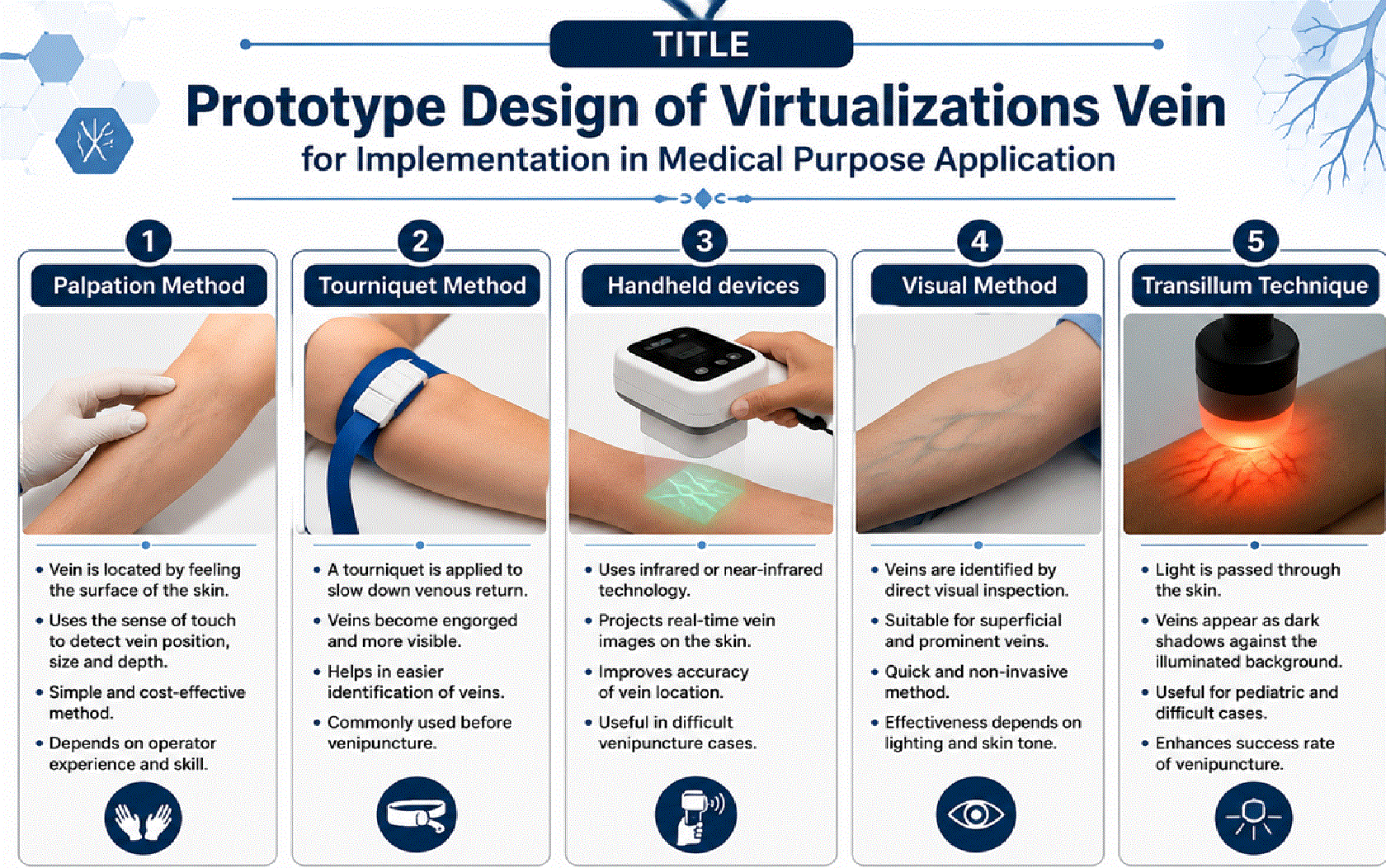
Prototype Design of Virtualizations Vein for Implementation in Medical Purpose Application
DOI:
https://doi.org/10.63912/kjaise.v1i0.0006Keywords:
LED Vein Finder, Prototype medical device, Non-invasive imaging, Real-time visualization, Vein localization, Venous access difficultAbstract
A novel LED-based vein finder prototype was developed to improve venous access during invasive procedures through real-time, non-invasive visualization. Traditional methods such as palpation and tourniquet application often fail, especially in pediatric, geriatric, and obese patients. The device utilizes visible-spectrum LED illumination to enhance vein contrast beneath the skin, enabling precise localization without discomfort. Its compact, lightweight design ensures usability across diverse clinical and field environments. Comparative analysis revealed higher accuracy, faster vein detection, and fewer needle insertion attempts compared to conventional techniques. The system supports improved first-attempt cannulation success and reduces procedural time. Enhanced workflow efficiency and minimized patient pain contribute to better clinical outcomes. Future improvements include software-based image enhancement and vein depth approximation. Broad clinical validation is recommended to establish performance across varying patient demographics and conditions.
References
[1] H. K. Al Ghozali, Setiawardhana, and R. Sigit, "Vein detection system using infrared camera," in Proc. 2016 Int. Electron. Symp. (IES), Denpasar, Indonesia, Sep. 2016, pp. 122–127, doi: 10.1109/ELECSYM.2016.7860987.
[2] W. F. Boron and E. L. Boulpaep, Medical Physiology, 2nd ed., updated. Philadelphia, PA, USA: Saunders/Elsevier, 2012.
[3] F. Chandra, A. Wahyudianto, and M. Yasin, "Design of vein finder with multi-tuning wavelength using RGB LED," J. Phys.: Conf. Ser., vol. 853, no. 1, Art. no. 012019, May 2017, doi: 10.1088/1742-6596/853/1/012019.
[4] M. S. Dhakshayani and S. M. Yacin, "Economically affordable and clinically reliable vein finder," in Proc. 30th Indian Eng. Congr.: The 21st Century Eng.—The Make in India Pathway, Guwahati, India, Dec. 2015, pp. 63–69. [Online]. Available: https://www.informaticsjournals.co.in/index.php/conference/article/view/46587
[5] M. D. Francisco et al., "Competitive real-time near-infrared (NIR) vein finder imaging device to improve peripheral subcutaneous vein selection in venipuncture for clinical laboratory testing," Micromachines, vol. 12, no. 4, Art. no. 373, Mar. 2021, doi: 10.3390/mi12040373.
[6] D. Helmi, W. Saad, and M. Khayyat, "Successful emerging technologies in nursing care," SAR J., vol. 6, no. 2, pp. 78–82, Jun. 2023, doi: 10.18421/SAR62-03.
[7] Y. Kanzawa, Y. Kimura, and T. Naito, "Human skin detection by visible and near-infrared imaging," in Proc. 12th IAPR Conf. Machine Vision Applications (MVA), Nara, Japan, 2011, pp. 503–506. [Online]. Available: https://www.mva-org.jp/Proceedings/2011CD/papers/14-22.pdf
[8] M. Lamperti and M. Pittiruti, "II. Difficult peripheral veins: turn on the lights," British Journal of Anaesthesia, vol. 110, no. 6, pp. 888–891, 2013, doi: 10.1093/bja/aet078.
[9] C.-T. Pan, M. D. Francisco, C.-K. Yen, S.-Y. Wang, and Y.-L. Shiue, "Pattern locating technology for cannulation: A review of low-cost vein finder prototypes utilizing near-infrared (NIR) light to improve peripheral subcutaneous vein selection for phlebotomy," Micromachines, vol. 10, no. 10, Art. no. 676, 2019, doi: 10.3390/s19163573
[10] A. S. Saju, L. Prasad, M. Reghuraman, and I. K. Sampath, "Use of vein-viewing device to assist intravenous cannulation decreases the time and number of attempts for successful cannulation in pediatric patients," Indian Journal of Clinical Anaesthesia, vol. 6, no. 3, pp. 366–370, 2019.DOI: 10.1002/pne2.12009.