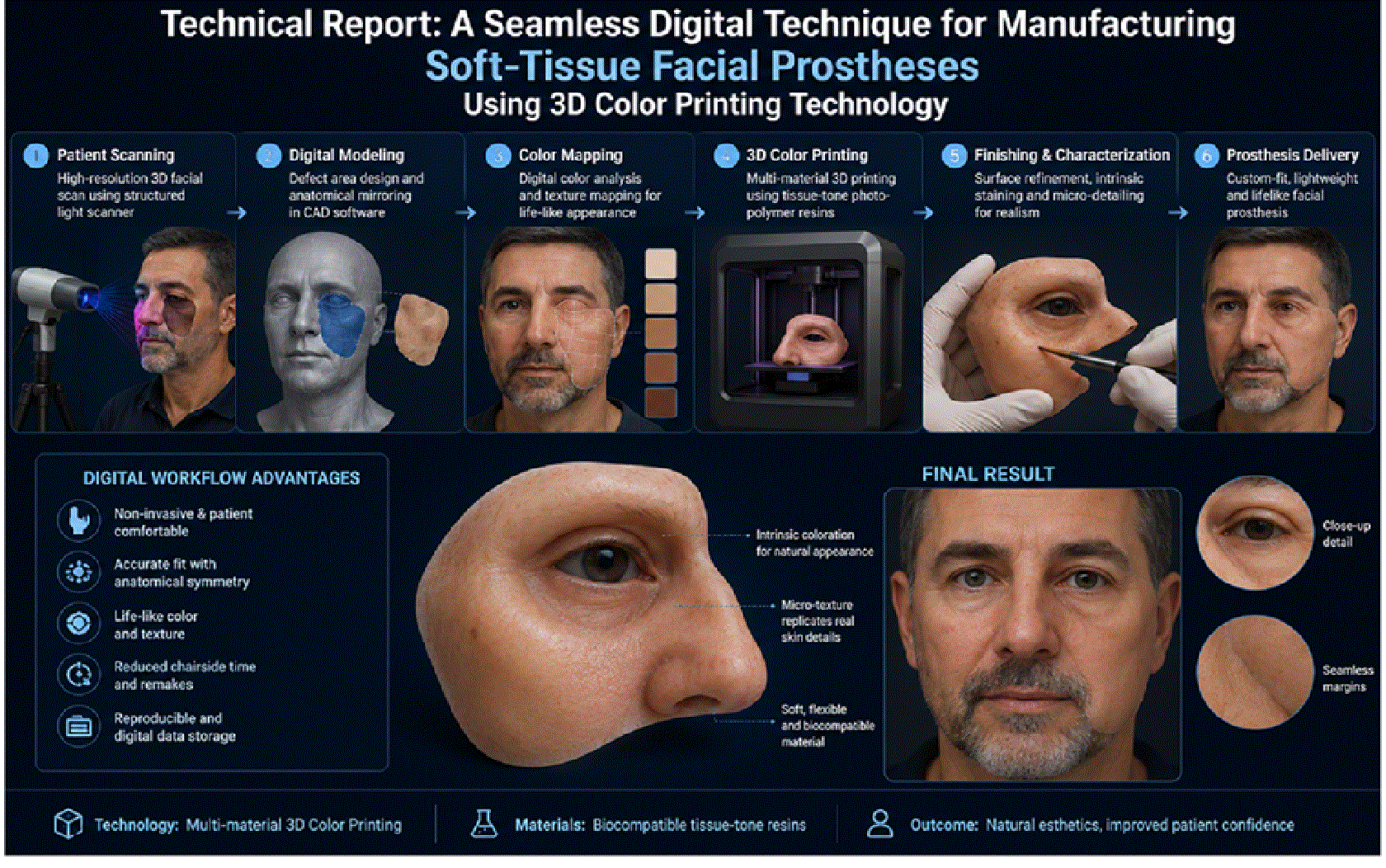
Technical report: A Seamless Digital Technique for Manufacturing Soft-Tissue Facial Prostheses Using 3D Color Printing Technology
DOI:
https://doi.org/10.63912/kjaise.v1i0.0002Abstract
This technical report presents a novel digital workflow for fabricating soft-tissue facial prostheses using full-color 3D printing technology. Developed from Faraedon Zardawi’s doctoral research, the method integrates 3D photogrammetry, CAD modeling with skin-tone mapping, binder-jet 3D printing (ZCorp Z510), and silicone elastomer infiltration (Sil‑25) to create lifelike, implant-retained facial prostheses. The workflow achieves significant improvements over traditional hand-crafted silicone prostheses in terms of color fidelity, reproducibility, fabrication speed, and patient comfort. A dedicated color management system ensures accurate and repeatable reproduction of skin tones. Mechanical and durability testing revealed that while the 3D printed prostheses exhibit reduced tensile strength and flexibility compared to conventional silicone, their color accuracy and aesthetic quality remain clinically viable for interim use. Infiltration depth and UV stability were also studied, highlighting areas for future material optimization. This approach is particularly suitable for patients undergoing healing post-surgery, offering a customizable, cost-effective, and easily reproducible interim solution with a functional life of 4–6 months. The digital archive of patient data allows for efficient updates to the prosthesis in response to tissue changes. Although limitations in mechanical performance and environmental stability persist, these are offset by clinical benefits and the potential to print multiple units for each patient. This work underscores the feasibility and future promise of 3D color printing in maxillofacial rehabilitation, bridging design innovation with patient-specific care.
References
[1] F. M. Zardawi, "Characterisation of implant-supported soft tissue prostheses produced with 3D colour printing
technology," University of Sheffield, 2013.
[2] K. Xiao, F. Zardawi, R. van Noort, and J. M. Yates, "Developing a 3D color image reproduction system for additive manufacturing of facial prostheses," The International Journal of Advanced Manufacturing Technology, vol. 70, no. 9, pp. 2043-2049, 2014.
[3] B. Ma, X. Yue, Y. Sun, L. Peng, and W. Geng, "Accuracy of photogrammetry, intraoral scanning, and conventional impression techniques for complete-arch implant rehabilitation: an in vitro comparative study," BMC Oral Health, vol. 21, no. 1, p. 636, 2021.
[4] C. M. Cristache, I. Tudor, L. Moraru, G. Cristache, A. Lanza, and M. Burlibasa, "Digital workflow in maxillofacial prosthodontics—an update on defect data acquisition, editing, and design using open-source and commercially available software," Applied Sciences, vol. 11, no. 3, p. 973, 2021.
[5] F. M. Zardawi and K. Xiao, "Optimization of maxillofacial prosthesis," 2019.
[6] F. M. Zardawi, K. Xiao, R. Van Noort, and J. M. Yates, "Investigation of elastomer infiltration into 3D printed facial soft tissue prostheses," Anaplastology, vol. 4, no. 139,pp. 2161-1173.1000139, 2015.
[7] F. M. Zardawi, K. Xiao, R. van Noort, and J. M. Yates, "Mechanical properties of 3D printed facial prostheses compared to handmade silicone polymer prostheses," European Scientific Journal, vol. 11, no. 12, 2015.
[8] K. Xiao, F. Zardawi, R. van Noort, and J. M. Yates, "Color reproduction for advanced manufacture of soft tissue prostheses," Journal of Dentistry, vol. 41, pp. e15-e23, 2013.
[9] F. M. Zardawi, D. G. Wildgoose, R. van Noort, and J. M. Yates, "Mechanical durability of 3D printed facial prostheses compared to traditional silicone polymer prostheses," European Scientific Journal, vol. 11, no. 24, 2015.
[10] F. M. Zardawi, N. Yadev, R. van Noort, and J. M. Yates, "In-Vitro Evaluation of the Cytotoxicity of Binders and Powder Used in 3D Colour Printing of Maxillofacial Soft Tissue Prostheses," IOSR Journal of Dental and Medical Sciences, vol. 14, no. 8, pp. 59- 64, 2015.
[11] Sun Y, Wang X, Chen J. Integration of structured-light scanning and CBCT for digital planning in maxillofacial prosthodontics. J Prosthet Dent. 2024;132(2):345-353.
[12] Al-Jabri R, Al-Fahad H. Digital photogrammetry workflows for facial prostheses: accuracy and reproducibility. Int J Oral Maxillofac Surg. 2025;54(1):88-95.
[13] HunterLab. How Spectrophotometers are Increasing Color Harmony and Stability in Maxillofacial Prosthetics. HunterLab Blog. 2023. Available from: https://www.hunterlab.com/blog/how-spectrophotometers-are-increasing-color-harmony-and-stability-in-maxillofacial-prosthetics
[14] Elbashti M, et al. The role of spectrophotometry and e-skin devices in accurate skin color matching for facial prosthetics. J Clin Med. 2024;13(9):2764. PMID: 10511671.
[15] Community innovation report: Two-part liquid silicone extrusion on consumer FDM platforms. Reddit, r/prusa3d. March 2025. Available from: https://www.reddit.com/r/prusa3d/comments/1jc7m5j
[16] Alenezi A, et al. Advances in 3D printing of maxillofacial prostheses: a 2025 scoping review. Appl Sci (Basel). 2025;15(4):1701.