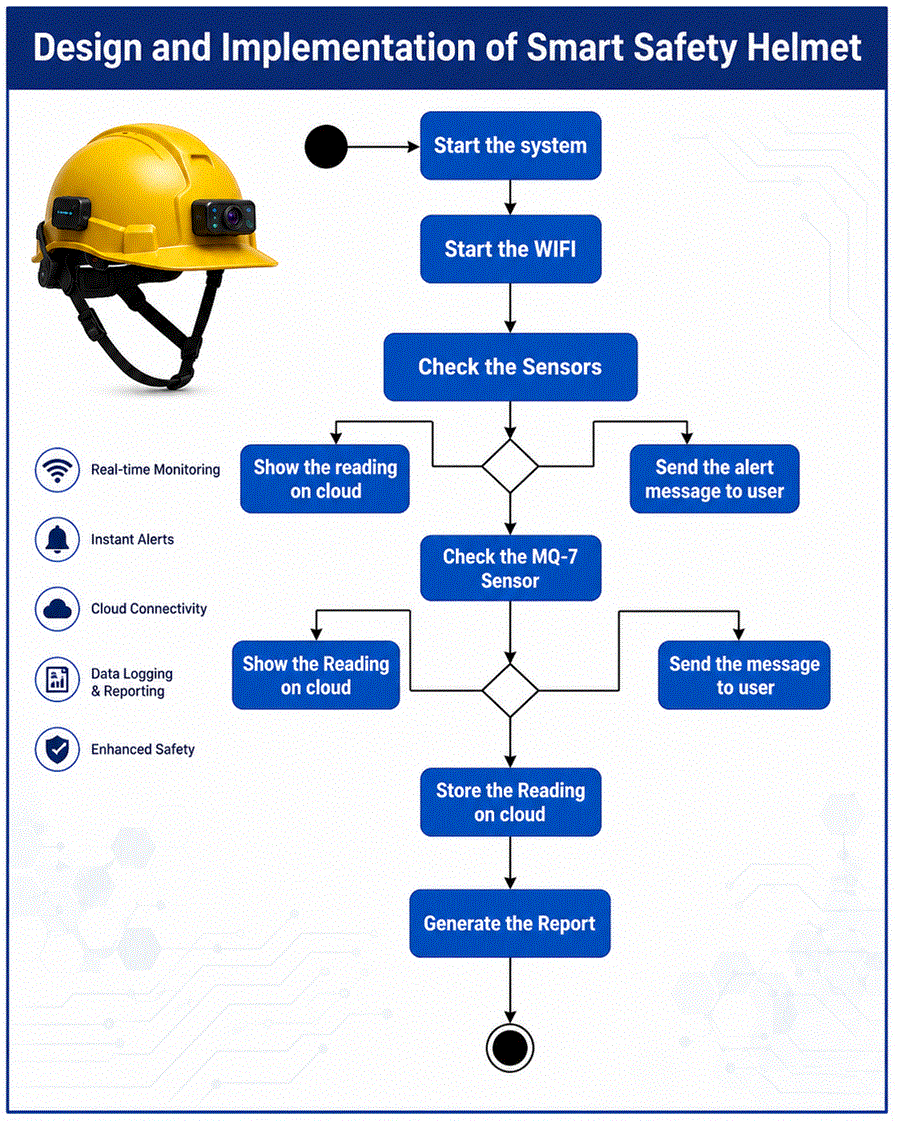
Design and Implementation of Smart Safety Helmet
DOI:
https://doi.org/10.63912/kjaise.v1i0.0007Keywords:
Safety, Smart Helmet, Sensors, Safety Applications.Abstract
In industries where workers face various hazards and risks, safety is a paramount concern. In this final year project, we propose a Safety and Worker Tracking Helmet using IoT to enhance safety measures and tracking capabilities in hazardous environments. The system utilizes Internet of Things (IoT) technology to provide real-time monitoring and tracking of workers, ensuring their well-being and enabling timely responses in case of emergencies. The main objective of this project is to design and develop a robust and efficient helmet that incorporates sensors, communication modules, and a central control unit to monitor vital parameters of workers and track their locations in hazardous areas. The Safety and Worker Tracking Helmet employs a network of sensors to monitor parameters such as temperature, humidity, gas levels, and heart rate. Any abnormal readings trigger immediate alerts to the control unit, which can be monitored by designated personnel on-site or remotely. Furthermore, the helmet is equipped with GPS and RFID technology to track the location of each worker within the work area, providing accurate and real-time information on their whereabouts. By leveraging IoT connectivity, the system enables seamless communication between the helmet, control unit, and monitoring personnel. This facilitates quick response and rescue operations in case of emergencies or accidents. Additionally, the collected data can be analyzed to identify patterns and trends, aiding in proactive safety measures and decision-making. The implementation of the Safety and Worker Tracking Helmet using IoT offers several benefits. Firstly, it enhances the safety and well-being of workers by continuously monitoring vital parameters and promptly alerting in case of any abnormalities. Secondly, the tracking feature ensures accurate and real-time location information, enabling efficient rescue operations and reducing response time in emergency situations. Moreover, the system promotes a safer work environment, allowing companies to comply with safety regulations and mitigate potential risks. The Safety and Worker Tracking Helmet using IoT is a valuable solution to enhance safety measures and tracking capabilities in hazardous environments. By incorporating IoT technology, the system provides real-time monitoring, alerts, and tracking of workers, contributing to a safer and more secure work operation. This project has the potential to significantly improve safety standards in various industries and protect the well-being of workers, ultimately leading to a more sustainable and secure work environment.
References
[1] P. Kuhar, K. Sharma, Y. Hooda, and N. K. Verma, “Internet of Things (IoT) based smart helmet for construction,” Journal of Physics: Conference Series, vol. 1950, no. 1, Art. no. 012075, Aug. 2021, doi: 10.1088/1742-6596/1950/1/012075.
[2] A. S. Abrar, Improving Radio Frequency Sensing for Smart Health Applications, Ph.D. dissertation, Washington University in St. Louis, St. Louis, MO, USA, 2020.
[3] J. E. Naranjo, C. A. Mora, D. F. Bustamante Villagómez, M. G. Mancheno Falconi, and M. V. Garcia, “Wearable sensors in industrial ergonomics: Enhancing safety and productivity in Industry 4.0,” Sensors, vol. 25, no. 5, Art. no. 1526, 2025, doi: 10.3390/s25051526.
[4] C. Domínguez-González et al., “Deoxynucleoside therapy for thymidine kinase 2–deficient myopathy,” Annals of Neurology, vol. 86, no. 2, pp. 293–303, 2019, doi: 10.1002/ana.25506.
[5] E. King, M. P. Smith, P. F. Wilson, and M. A. Williams, “Digital responses of UK museum exhibitions to the COVID-19 crisis, March–June 2020,” Curator: The Museum Journal, vol. 64, no. 3, pp. 487–504, 2021, doi: 10.1111/cura.12413.
[6] J. Roberts et al., “New orbital constraints for YSES 1 b and HR 2562 B from high-precision astrometry and planetary radial velocities,” The Astronomical Journal, vol. 170, no. 5, Art. no. 273, 2025.
[7] J. S. Lee, J. H. Jun, D. H. Kim, and S. J. Oh, “Implementation of a patient risk behavior monitoring system using real-time sensor data and AI,” IEEE Access, 2025.
[8] Y. Liang, Y. Liu, C. Lu, D. Cui, J. Yang, and R. Zhou, “Research on intelligent monitoring and protection equipment of vital signs of underground personnel in coal mines,” Sensors, vol. 25, no. 1, Art. no. 63, 2024, doi: 10.3390/s25010063.
[9] R. Riti, J. Dhangar, and S. Tiwari, “A smart helmet solution for mining safety using IoT and wearable sensing technologies,” in Proc. 2nd Global AI Summit – Int. Conf. Artificial Intelligence and Emerging Technology (AI Summit), Nov. 2025, pp. 329–334.
[10] S. H. Berge, J. De Winter, and M. Hagenzieker, “Support systems for cyclists in automated traffic: A review and future outlook,” in Deliverable 2.5: Design Strategies and Prototype HMI Designs for Cyclists, Pedestrians, and (Non-Automated) Cars, Appendix B, 2023. .
[11] S. Kim, M. A. Nussbaum, and J. L. Gabbard, “Augmented reality ‘smart glasses’ in the workplace: Industry perspectives and challenges for worker safety and health,” IIE Transactions on Occupational Ergonomics and Human Factors, vol. 4, no. 4, pp. 253–258, 2016, doi: 10.1080/21577323.2016.1214635
.